Installation
A series of interactive audiovisual installations that explore the body, communication, and control within technologically mediated environments. Using tools such as Arduino, TouchDesigner, sensors, and webcams, the works challenge seamless interaction by foregrounding refusal, disruption, and the body as an active agent within digital systems.
concrete ghosts
created for Mplimplikia, SNFCC Youth Council
concrete ghosts is a live audiovisual performance where real-time audio from DJ sets and live acts drives a sound-reactive visual system in TouchDesigner, transforming industrial landscapes into signal and noise. Footage of abandoned infrastructures glitches and mutates in real time. A floating cube prism cuts through these spaces; a scanning body and container, directly modulated by sound.
Both the prisms and the underlying image respond to audio input, shaping distortion, rhythm, and fragmentation. As the system reacts, surfaces burn, leak, and collapse into light. Architecture becomes unstable, almost sentient. No longer a site of production, but a carrier of data residue. The work operates as a feedback loop between sound and image, transforming documentation into a living structure that performs its own decay.
Violation/Refusal
an interactive audiovisual installation created with Arduino and Processing that explores bodily autonomy, consent, and refusal. A proximity sensor drives a responsive digital skin that shifts from calm to distress as the viewer approaches, eventually withdrawing entirely. By rejecting seamless interaction, the work frames proximity as an ethical encounter where the digital body asserts boundaries and retains traces of past violations.
Static Between Us
an interactive audiovisual installation created with TouchDesigner that explores how technology mediates and disrupts human communication. Viewers are invited to respond to familiar, platform-like prompts, but every attempt to speak triggers visual distortion and static noise. Communication becomes possible only when participants turn away from the system and toward each other, framing human connection as an act of resistance to surveillance and mediated interaction.
Cyborg, Reversed
an interactive visual installation developed with Arduino, a pulse sensor, and TouchDesigner that rethinks the relationship between body and technology. The viewer’s heartbeat directly controls the visual system in real time, transforming the digital environment into a responsive, dependent entity. By reversing the usual dynamic of control, the work positions the body as the driving force, framing technology as vulnerable and contingent on human presence.
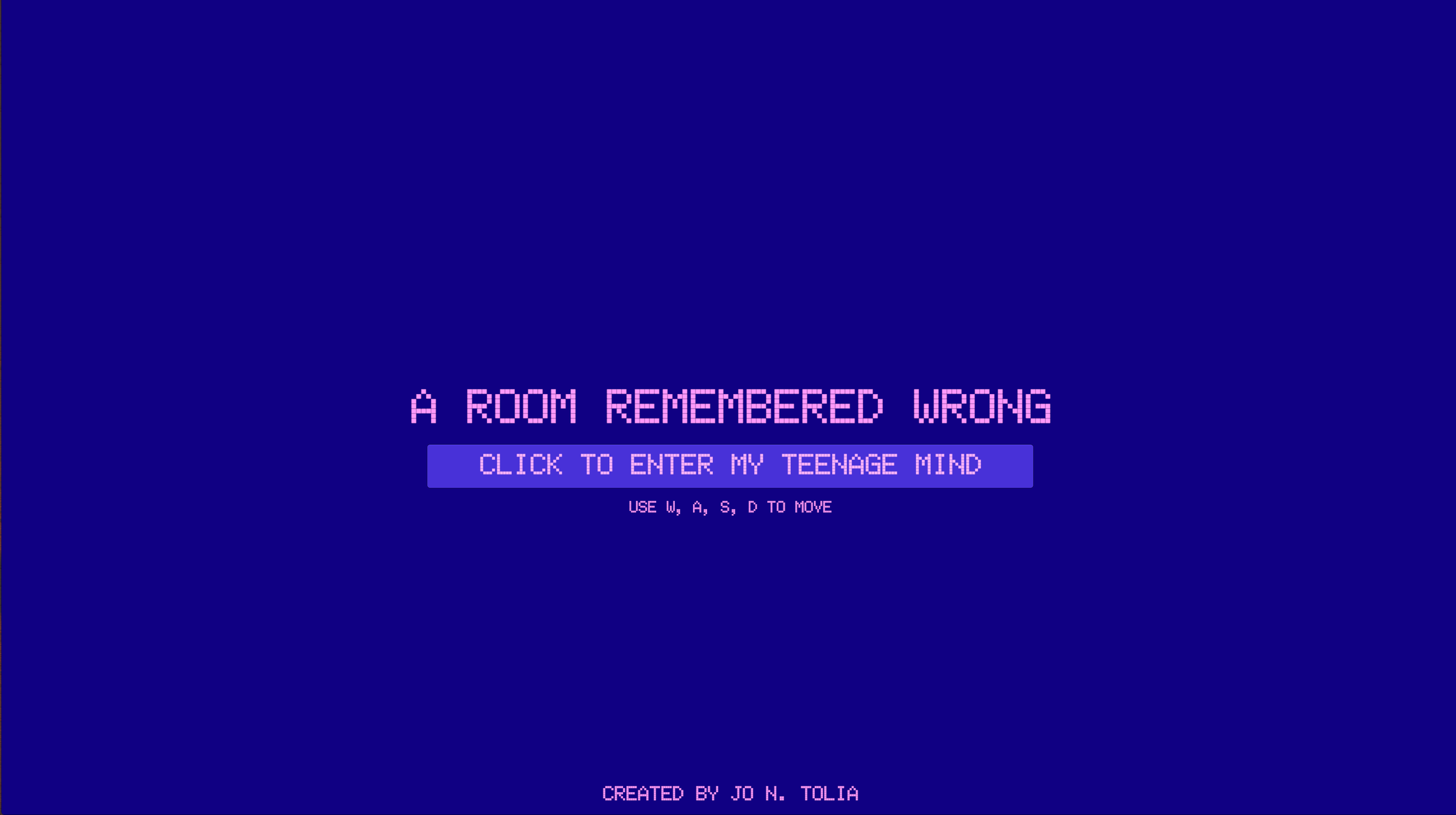
a room remembered wrong
an interactive first-person virtual environment created in Unity. The project reconstructs my teenage bedroom as a fragmented memory space, combining 3D assets, modified models, ambient sound, atmospheric lighting, UI elements, and C# interaction scripts. The user enters the room and navigates through objects that function as memory triggers: a bed activates a dream sequence, a CD player opens a playable playlist, and a set of books unfolds into floating covers and text fragments. Rather than functioning as a game with goals or progression, the work is designed as a small digital installation where interaction, sound, and light turn a domestic interior into an intimate archive of remembered objects.